



KLHDC2
KLHDC2 (Kelch Domain Containing 2) functions as a substrate receptor of the CRL2 (Cullin-RING Ligase 2) E3 ubiquitin ligase complex and plays a central role in protein quality control through selective recognition of C-terminal degrons.[1] Mechanistically, KLHDC2 recognizes proteins carrying a C-terminal diglycine (Gly-Gly) C-end degron, including aberrant proteins, early-terminated selenoproteins, and proteolytic fragments, and directs their ubiquitination and proteasomal degradation.[1] Structural studies demonstrated that KLHDC2 binds diglycine C-end degrons with nanomolar affinity through a deep substrate-binding pocket and an extensive hydrogen-bonding network, providing a molecular basis for high-specificity substrate recognition.[1] This pathway contributes to the maintenance of protein homeostasis, and genetic studies indicate that KLHDC2 is essential for normal development because homozygous Klhdc2 knockout mice exhibit embryonic lethality.[1] Mechanistically, KLHDC2 activity is regulated by transitions between inactive tetrameric assemblies and active monomeric CRL2KLHDC2 complexes, in which its own C-terminal motif can mimic a degron and mediate autoinhibition.[2] Compared with related family members such as KLHDC1, KLHDC3, and KLHDC10, KLHDC2 exhibits distinct substrate selectivity for Gly-Gly C-degrons and has emerged as a uniquely tractable E3 ligase for targeted protein degradation strategies.[3] For experimental applications, structure-guided ligands and PROTAC platforms that recruit KLHDC2 have enabled selective degradation of target proteins, expanding the repertoire of E3 ligases available for chemical biology and drug discovery research.[3][4]
References:
- [1]. Rusnac DV, et al. Recognition of the Diglycine C-End Degron by CRL2KLHDC2 Ubiquitin Ligase. Mol Cell. 2018 Dec 6;72(5):813-822.e4. [Content Brief]
- [2]. Sandmann CL, et al. Evolutionary origins and interactomes of human, young microproteins and small peptides translated from short open reading frames. Mol Cell. 2023 Mar 16;83(6):994-1011.e18. [Content Brief]
- [3]. Scott DC, et al. Principles of paralog-specific targeted protein degradation engaging the C-degron E3 KLHDC2. Nat Commun. 2024 Oct 12;15(1):8829. [Content Brief]
All Product Categories
-
KLHDC2 Related Products (7)
Related Products (7)

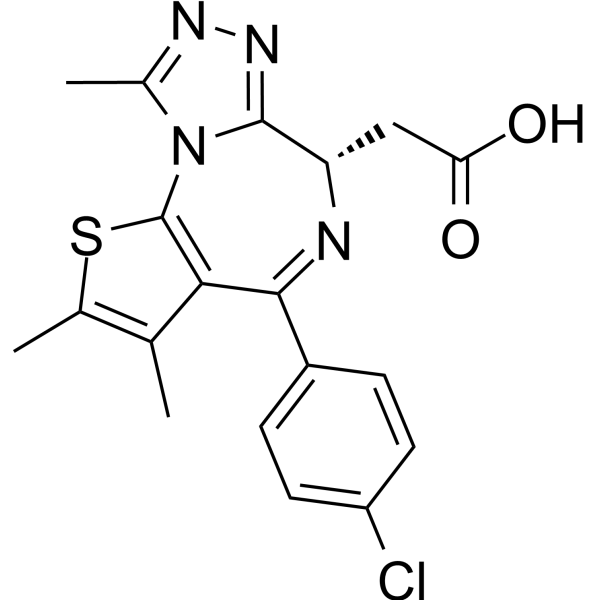
-
KLHDC2 ligand 3
 0 ImagesCat. No.: HY-180280KLHDC2 ligand 3 is an E3 ligase ligand. KLHDC2 ligand 3 can be used for the synthesis of PROTAC CDK6 Degrader 1 (HY-180277).
-
KLHDC2 ligand 4
 0 ImagesCat. No.: HY-180263KLHDC2 ligand 4 (compound KL-3 (8)) is an E3 ligase ligand that can be used for synthesis of PROTAC CDK6 Degrader 2 (HY-180262).
-
SJ46411
 0 ImagesCat. No.: HY-168536CAS No.: 3086104-39-1SJ46411 is a potent ligand for KLHDC2, with a Kd of ~260 nM measured by isothermal titration calorimetry (SPR Kd = 0.5 μM, TR-FRET IC50 = 3.9 μM, ΔTm = 6.0 °C).
-
KDRLKZ-1
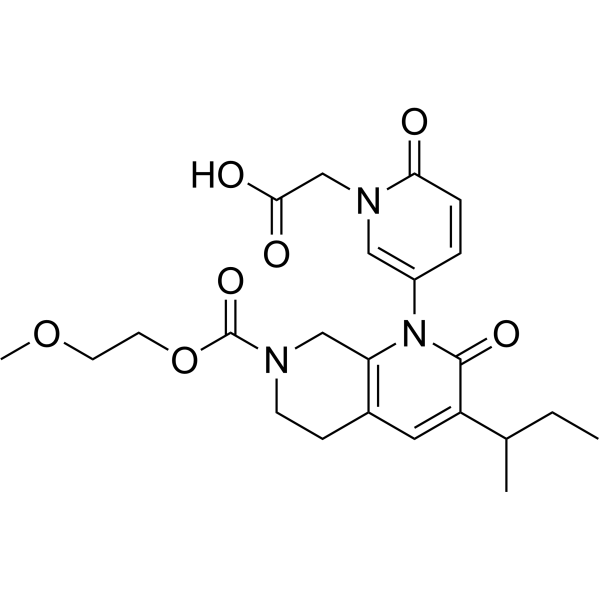 0 ImagesCat. No.: HY-157558Synonyms: 8SGEKDRLKZ-1 (8SGE) is a small-molecule ligand of KLHDC2 E3 ligase (Kd = 0.36 μM), with an IC50 of 0.21 μM and 0.31 μM in alphaLISA and TR-FRET assays, respectively. KDRLKZ-1 binds to the substrate-binding pocket of the KLHDC2 kelch domain, mimics the interaction of natural substrates and displaces them. KDRLKZ-1 acts as an oligomer disruptor, regulates the oligomerization of the KLHDC2-EloB-EloC complex, and induces the dissociation of tetramers into smaller components. KDRLKZ-1 can be used in scaffold ligand research for PROTAC degraders targeting KLHDC2.
-
Me-SJ46411
 0 ImagesCat. No.: HY-159973Me-SJ46411 is an E3 ubiquitin ligase ligand, which can be used for the synthesis of PROTAC molecules. For example, Me-SJ46411 combined with PROTAC linker Boc-Piperazine-OH (HY-20797) and target protein ligand (+)-JQ-1 (HY-13030) can be used to synthesize the selective BRD3 PROTAC degrader SJ46420 (HY-168635)..
-
SJ6145
 0 ImagesCat. No.: HY-168535CAS No.: 1010913-79-7



